

UNISOC Released the New-generation 5G RedCap Platform V527 to Accelerate the Global Extensive Application of 5G
SHANGHAI, CHINA, January 30, 2026 /EINPresswire.com/ --
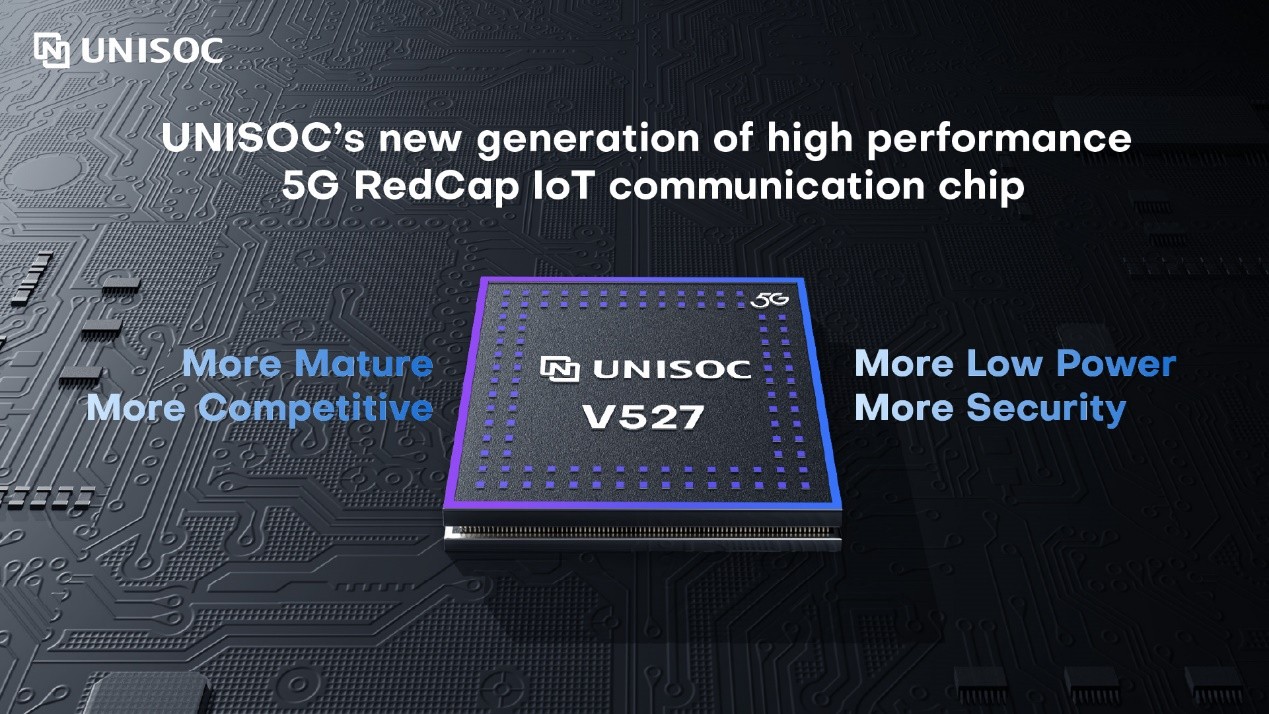
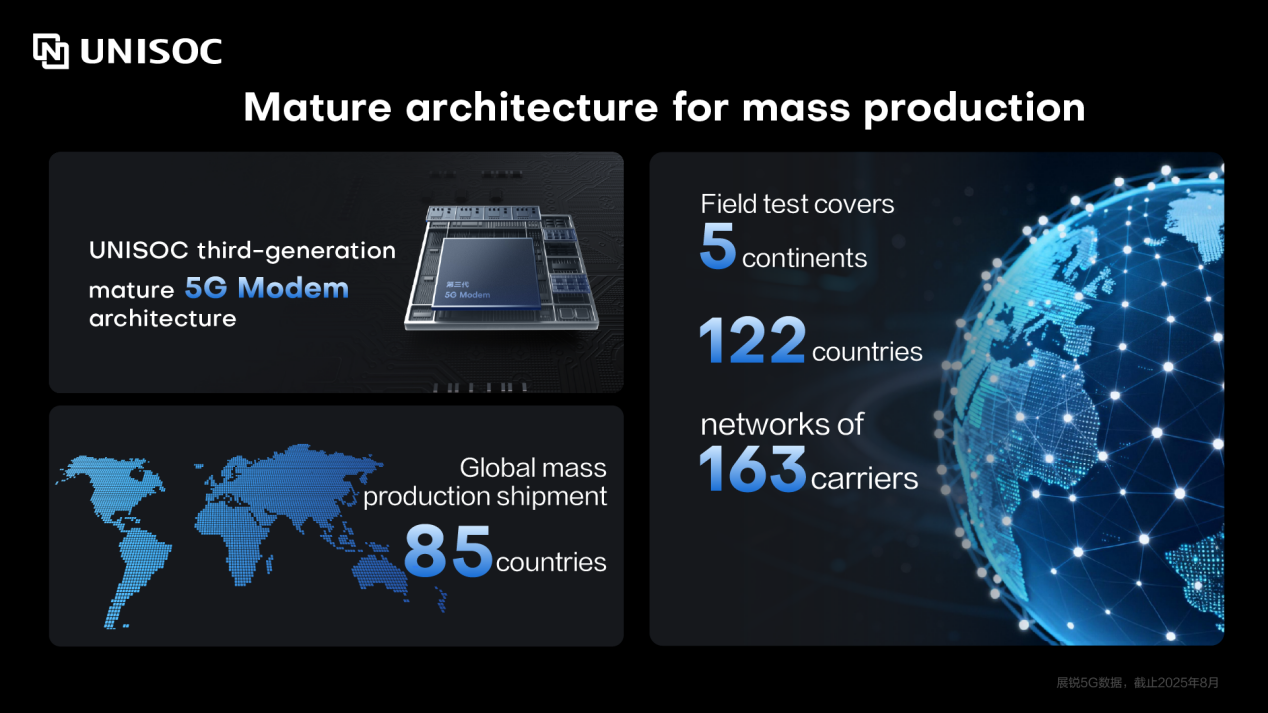
Recently, UNISOC officially launched its next-generation high-performance 5G RedCap IoT communication chipset, the V527. As UNISOC second-generation flagship RedCap platform, the V527 is developed based on the 3GPP Release 17 standard and incorporates UNISOC mature third-generation 5G modem architecture. It delivers comprehensive upgrades in communication performance, system compatibility, energy efficiency, and security systems, providing a reliable and stable solution for large-scale global deployment of 5G RedCap.
More Mature: Covering 122 Countries and Regions Worldwide
5G RedCap technology significantly reduces 5G costs and power consumption by simplifying terminal RF and baseband complexity. Currently, UNISOC 5G platform has made mass shipments in 85 countries and regions globally, with network adaptation and field testing completed for 163 operators across 122 countries and regions.
UNISOC V527 not only supports 5G high-precision timing, 5G slicing, and 5G LAN, but also covers key features such as TSN, URLLC, UTDOA/ECID high-precision positioning, SRS, and SUL. The V527 delivers stable, precise, and sustainable connectivity for robot scheduling in smart factories, real-time control in port automation, time synchronization in power systems, stable coordination of mining equipment, and enterprise private networks demanding high security and determinism. This enables industries to achieve “predictable industrial-grade communication” over wireless networks.
More Powerful: Full Sub-6GHz Range Support
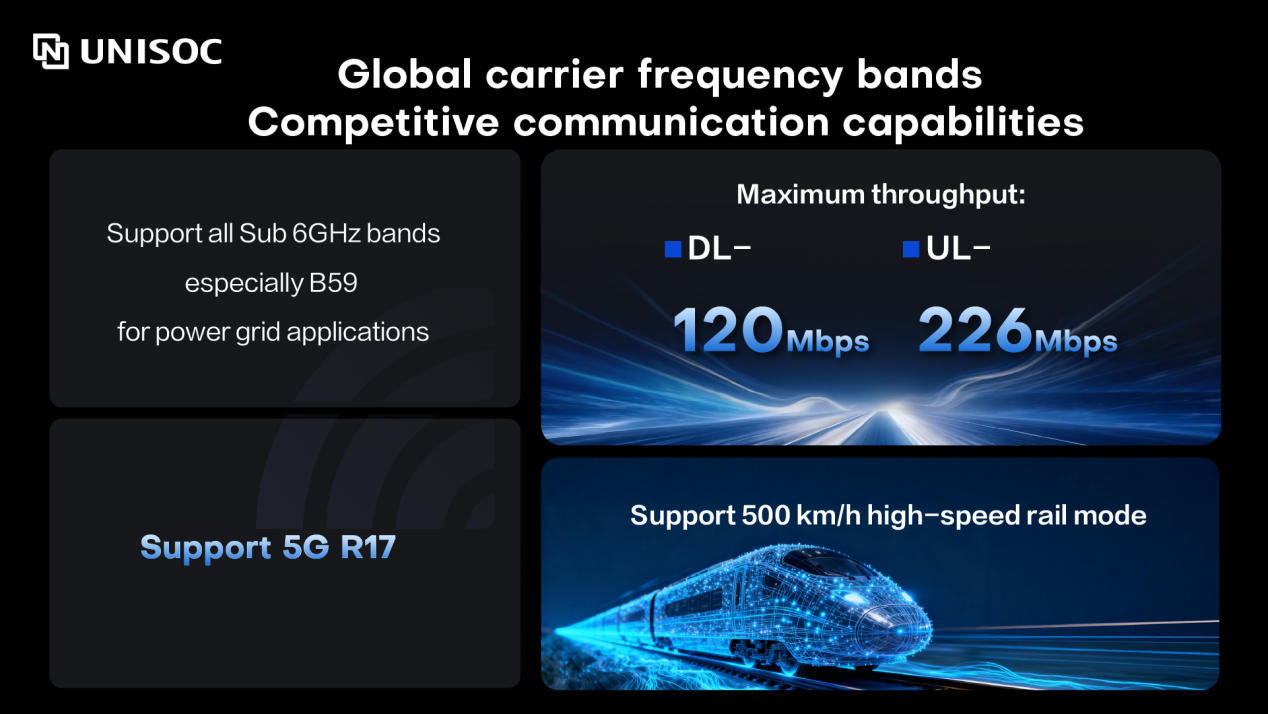
UNISOC V527 supports the full Sub-6GHz range, enabling compatibility with network deployment from major global carriers. It also supports the B59 frequency band dedicated to the power industry, providing a stable network foundation for scenarios such as power IoT, energy private networks, and industrial control.
UNISOC V527 offers a maximum downlink speed of 226 Mbps and a maximum uplink speed of 120 Mbps, meeting the robust uplink capacity demands of industry scenarios such as mobile video capture, real-time monitoring, unmanned device communication, and industrial sensing. The V527 also supports mobility up to 500 km/h, enabling its deployment in rail transit, smart logistics, and high-speed mobile terminals. Regarding coverage capabilities, the V527 achieves ultra-long-range communication spanning 100 kilometers through SUL, channel repetition, and multi-slot enhancement. This ensures stable 5G connectivity even in challenging environments like remote mining areas, power lines, and telemetry equipment.
More Energy Efficient: 13% Lower Power Consumption
In terms of energy efficiency, thanks to UNISOC latest PM2 low-power architecture, the V527 achieves a further 13% reduction in main chipset power consumption during sleep mode. This is particularly significant for scenarios requiring extended battery life, such as mobile surveillance devices, low-power sensors, energy metering equipment, and outdoor deployment devices. Additionally, the R17 energy optimization mechanism enables the V527 to dynamically adjust power consumption based on real-world network demands, further enhancing overall device endurance.
Designed for complex engineering environments, UNISOC V527 integrates a comprehensive suite of standard interfaces to meet the demands of diverse product categories. The V527 also supports extended temperature range from -40°C to +85°C, ensuring stable performance in industrial-grade scenarios characterized by extreme cold, heat, humidity, and dust. It serves industries with stringent reliability requirements, including mining operations, energy facilities, rail transit, and smart urban management.
More Secure: National Cryptographic Standard Protection
UNISOC V527 builds comprehensive security capabilities across hardware, systems, and data. The chipset integrates a TEE (Trusted Execution Environment) hardware module with hardware access control and a root of trust, supporting multiple security algorithms including national cryptographic standards SM2, SM3, SM4, as well as RSA, ECC, and SHA. It meets stringent security requirements for industries such as energy, industrial control, financial devices, and vehicle networking. Additionally, the V527 provides system-level security mechanisms including secure boot, secure storage, program integrity protection, and data encryption. This ensures that devices operate in a trusted state throughout network connectivity, software updates, data transmission, and execution processes.
Thus far, UNISOC has developed multiple solutions based on the V527 chipset, collaborating with industry partners to drive the large-scale adoption of RedCap and build a new 5G ecosystem for vertical industries.
Note: Data in this article is sourced from UNISOC laboratory testing. Actual results may vary slightly depending on the version and testing environment.
UNISOC PR department
UNISOC(Shanghai)Technologies Co., Ltd.
2120360600 ext.
email us here
Legal Disclaimer:
EIN Presswire provides this news content "as is" without warranty of any kind. We do not accept any responsibility or liability for the accuracy, content, images, videos, licenses, completeness, legality, or reliability of the information contained in this article. If you have any complaints or copyright issues related to this article, kindly contact the author above.
