

Artificial Intelligence for Optical Metasurface Design: From Unit-Cell Optimization to System-Level Integration
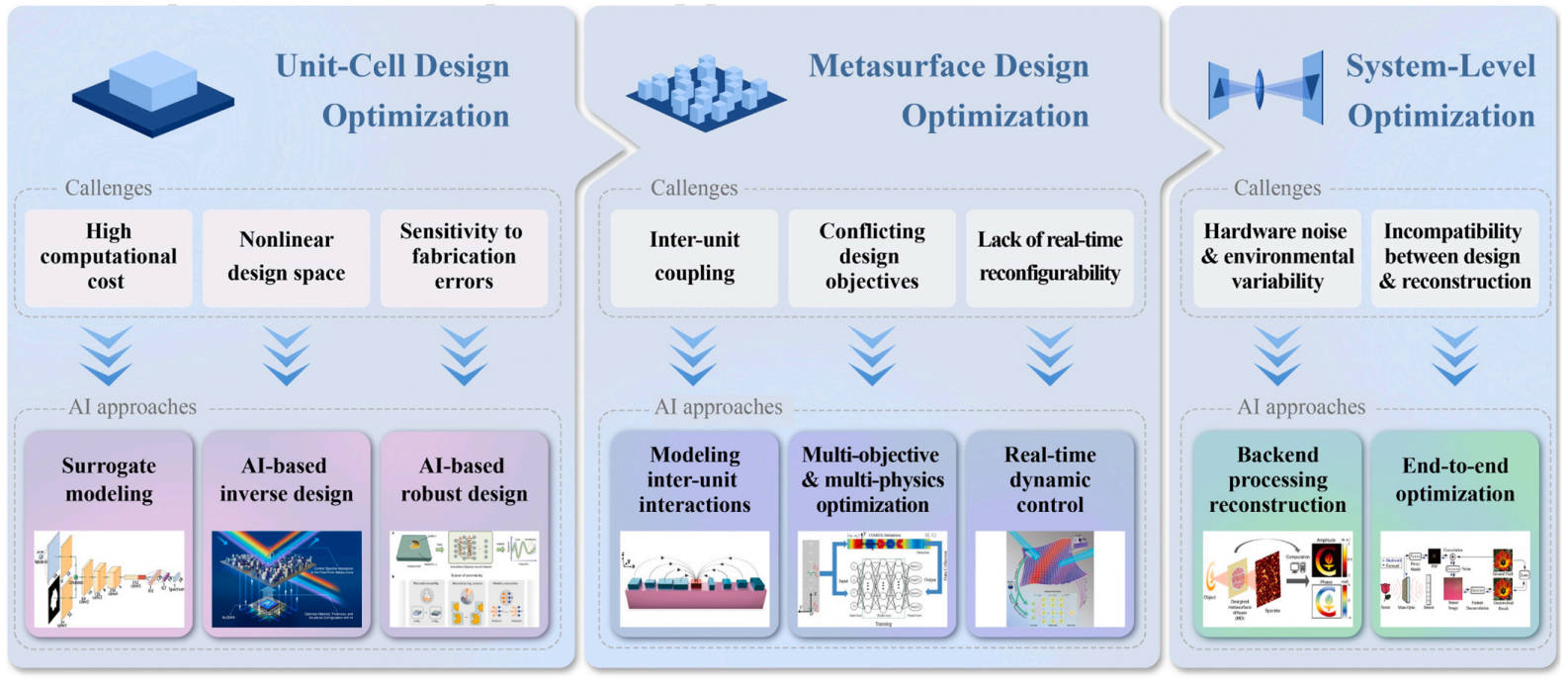
SYSTEM ARCHITECTURE OF AI-EMPOWERED METASURFACE DESIGN.
GA, UNITED STATES, December 8, 2025 /EINPresswire.com/ -- New review in iOptics demonstrates how AI is overcoming key challenges in metasurface design, enabling advanced applications in compact optics and computational imaging.
Optical metasurfaces, with their ultra-thin and lightweight properties, are driving the miniaturization and planarization of optical systems. However, their development from unit-cell design to system integration faces challenges. A new review article published in iOptics reveals how artificial intelligence (AI) is providing solutions for metasurface technology to transition from unit optimization to system-level integration.
The review, led by Professor Xin Jin from Tsinghua University, outlines how AI addresses challenges at each design stage. At the unit-cell level, AI-driven surrogate modeling accelerates electromagnetic response prediction, while inverse design frameworks explore complex solution spaces. Robust design methods enhance stability against manufacturing variations.
“For metasurface optimization, AI methods like graph neural networks model non-local interactions between densely packed meta-atom,” shares Jin. “Multi-task learning resolves conflicting performance objectives, and reinforcement learning enables real-time dynamic control.”
At the system level, AI provides a unified differentiable framework that integrates structural design, physical propagation models, and task-specific loss functions. “This end-to-end optimization directly links nanostructure design to final application goals, overcoming incompatibility between metasurface design and backend algorithms,” adds Jin. “AI is shifting metasurface design from traditional, staged methods toward intelligent, collaborative, and system-level optimization.”
Notably, application areas benefiting from AI-driven metasurfaces include compact imaging systems, augmented/virtual reality (AR/VR) displays, advanced LiDAR, and computational imaging systems.
The review also identifies future research directions, including developing AI methods integrated with electromagnetic theory, creating unified architectures for multi-scale design, and advancing adaptive photonic platforms.
Original Source URL
https://doi.org/10.1016/j.iopt.2025.100004
Funding information
This work is supported in part by Shenzhen Science and Technology Program under Grant JCYJ20241202123921029; in part by Natural Science Foundation of China under Grant 62131011 and in part by the Major Key Project of PCL under Grant PCL2023A10–3.
Lucy Wang
BioDesign Research
email us here
Legal Disclaimer:
EIN Presswire provides this news content "as is" without warranty of any kind. We do not accept any responsibility or liability for the accuracy, content, images, videos, licenses, completeness, legality, or reliability of the information contained in this article. If you have any complaints or copyright issues related to this article, kindly contact the author above.
